
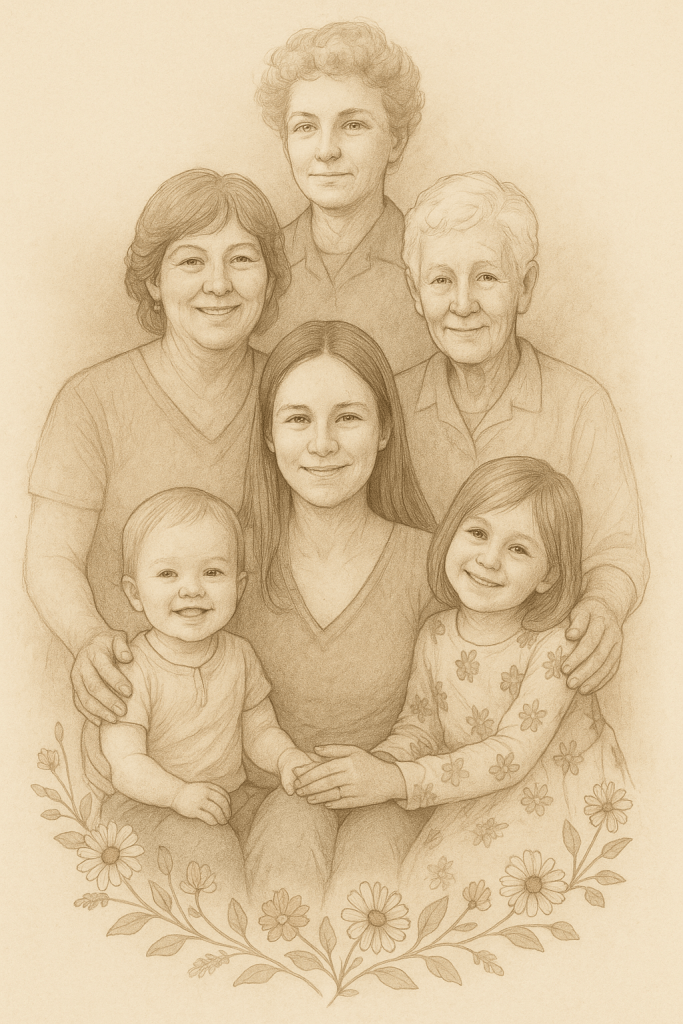
Grief does strange things.
It sends you digging through memory, through stories, through the quiet corners of family conversations you never lingered in before.
I was looking for Nanny.
For pieces of her I hadn’t written down yet. For proof that she really was as strong as I remember. For comfort, if I’m honest. Somewhere in the middle of talking with family, her name led to another, almost casually mentioned, like folklore you half expect to be exaggerated.
Jenny Wiley.
I assumed it was one of those family legends. The kind everyone has. Someone brave. Someone tragic. Someone far enough back that no one questions it too hard.
Except this time, there were records. And then more records. And then deeper research. And then ancestry and DNA connections that made it harder to shrug off.
Apparently, the women in my family don’t do things the easy way.
Jenny Wiley lived in the late 1700s on the Kentucky frontier. She was captured during a raid, lost her children, survived years of brutality, and eventually escaped walking hundreds of miles back to civilization alone.
There’s no inspirational bow on that story. No lesson neatly wrapped in twine. It wasn’t brave in the way we like to tell stories now. It was brutal in the way survival sometimes is. She endured because there was no other option.
History doesn’t soften that. It shouldn’t.
There’s also complexity there and violence layered on violence, suffering on all sides, a time shaped by cruelty and loss in ways we can’t romanticize or simplify. This isn’t a heroic myth. It’s a human one.
And that’s why it landed the way it did.
Because I didn’t see myself in her pain. I saw myself in her continuation.
Nanny survived too just in quieter ways. Through poverty, loss, motherhood, responsibility. Through putting herself last because someone always needed something. She didn’t escape a wilderness. She held a family together.
My mom belongs in this lineage too, even if she’d never frame it that way.
She lost her dad at eight years old, the kind of loss that rewires a childhood permanently. And when it came time to become a mother herself, she did it without the fairy tale. My biological father bailed before she could even finish peeing on the stick. No buildup. No apology. Just absence.
She didn’t get the luxury of falling apart for long. Life kept coming. Bills, responsibility, motherhood, survival. And she met it the way the women before her always had by getting up and doing what needed to be done, even when it wasn’t fair, even when it was heavy, even when no one was watching.
She’s never had it easy. But she’s also never quit.
That kind of perseverance doesn’t announce itself. It doesn’t demand recognition. It just keeps going. And somehow, it becomes the foundation everyone else stands on.
Different centuries. Same demand.
And here I am modern comforts, modern chaos, still carrying the invisible work of keeping everyone moving forward. Feeding people. Loving people. Absorbing things quietly so the house doesn’t collapse.
Apparently, resilience is hereditary.
Unfortunately.
This isn’t me claiming strength as a badge. It’s me recognizing a pattern. The women before me didn’t survive so we could be inspirational. They survived because life required it. And then they taught the next generation how to do the same often without ever naming it.
I don’t honor them by pretending it’s easy.
I honor them by telling the truth.
The women before me survived.
The least I can do is speak honestly about it.


 Crumbs and Chaos
Leave a comment